In today’s increasingly competitive legal landscape, adopting a practical, robust Matter Management or Legal Project Management (LPM) framework is no longer optional — it’s essential for delivering consistent, high-quality outcomes.
Just as industries such as Financial Services, Healthcare, Engineering, and Technology rely on structured methodologies like PRINCE2, Agile, and Waterfall, the legal sector is now recognising the value of applying disciplined, professional approaches to managing large, complex matters.
This article is the first in a Telescope thought-leadership series. We’ll be drawing on collective experience from across the industry — including contributions from private practice, in-house teams, and legal operations leaders — to explore how matter management, outside counsel management, and legal project management can be elevated.
Why a matter management framework matters
A matter management framework should provide simple, clear principles that help lawyers and legal project managers plan, organise, and monitor matters effectively — reducing surprises and ensuring every action aligns with scope, objectives, and client expectations. Above all, it must be flexible enough to adapt to each matter, client, and partner.
Over the last decade, the rise of dedicated legal project managers reflects a shift in how firms handle complexity, as outlined in the Association of Corporate Counsel’s (ACC) Legal Operations Maturity Model. Large matters are inherently unpredictable: client success criteria evolve, scopes shift, and counterparties respond dynamically. A practical, common framework is crucial for navigating this uncertainty, empowering teams to maintain control, communicate clearly, and deliver reliably.
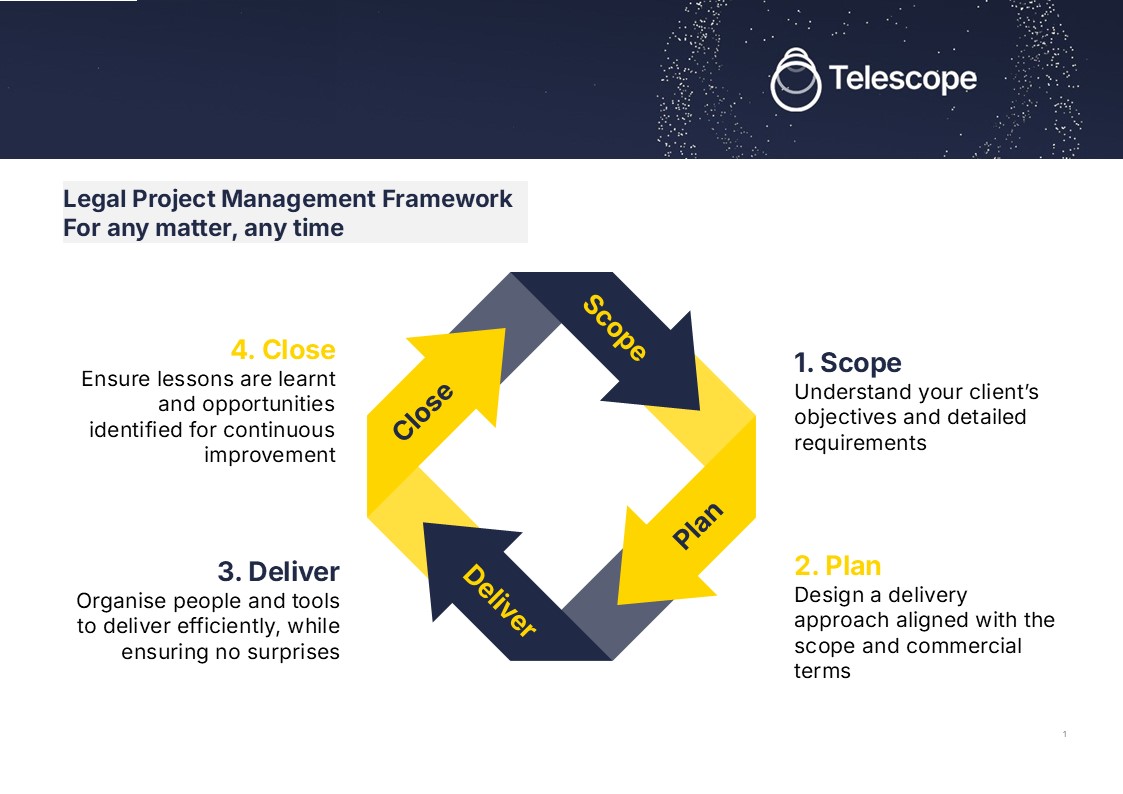
An effective framework
- Scope: Understand the client’s objectives and assumptions. Asking the right questions early builds transparency and sets the foundation for alignment.
- Plan: Design a delivery plan that reflects scope, complexity, commercial terms, timelines, communication channels, resourcing decisions, and appropriate technology. The plan should be proportional and pragmatic.
- Deliver: Coordinate people and tools, manage risks, monitor progress, and provide regular reporting to ensure there are no surprises for internal or external stakeholders.
- Close: Capture lessons learned, gather client feedback, and ensure knowledge retention. This closing discipline drives constant improvement.
Integrating these principles into legal practice enhances service delivery while enabling firms and legal teams to operate with greater discipline, predictability, and efficiency.
For in-house legal and outside counsel management teams, having a practical methodology is now essential for navigating modern legal complexity and achieving successful business outcomes.
About Telescope
Telescope is redefining how legal matters are managed, bringing visibility, control, and confidence to every stage of a case or transaction. Built for modern legal teams, our platform connects scope, delivery, and value through an intelligent matter management system that goes far beyond task tracking.
We enable firms and in-house teams to scope complex projects accurately, monitor progress in real time, and manage costs with precision.
Next-generation matter management starts here — contact us at Telescope.
By Aaran Scott, a global legal operations strategist and keynote speaker, drawing on 10+ years of partnering with leading law firms to transform matter management and deliver exceptional client value.
One thought on “Legal Matter Management, Unlocking Better Client Outcomes”
Comments are closed.