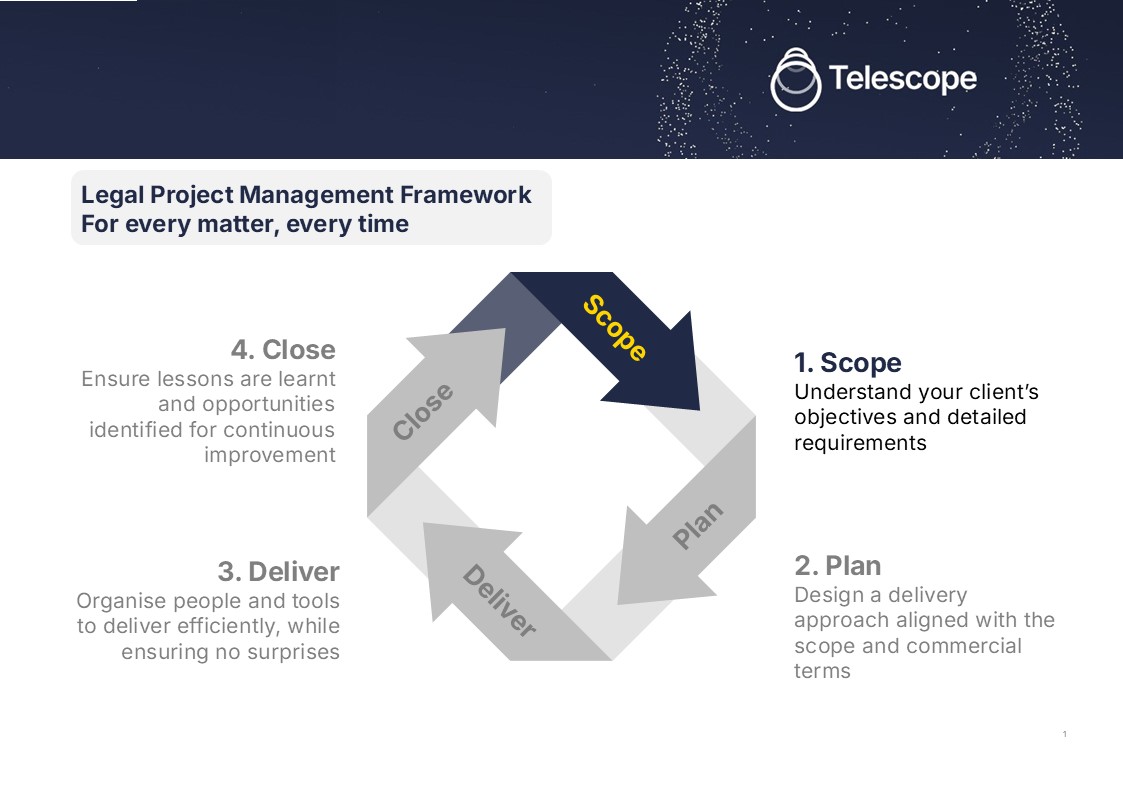
Agreeing on an effective fee arrangement (EFA) is only the beginning; law firms and clients must collaborate closely to maintain rigorous scope control throughout the lifecycle of complex legal matters. Without robust scope management, even the best fee arrangements can fail to deliver value, leading to cost overruns, delays, and dissatisfied clients.
For lawyers, LPMs, legal operations, and legal innovation professionals, whether in-house or at law firms, scope management is a critical driver of successful outcomes and client satisfaction. In today’s competitive legal market, where clients demand predictability and transparency, mastering scope management is essential for delivering value and building trust.
Here are some common pitfalls and strategies to consider when navigating scope.
Inadequate information: Clients expect clarity and precision from the start. Defining the scope accurately is crucial to avoiding misunderstandings and misaligned expectations. However, the unpredictable nature and duration of many legal matters can make this challenging.
- Tip: Scope the next 90 days or a specific phase of work, rather than the entire matter. This phased approach provides clients with clarity and allows for regular review and adjustment as the matter evolves.
- Tip: Engage clients early with targeted questions to clarify assumptions, set expectations, and establish a transparent foundation for the matter.
Scope creep: As legal matters progress, scope can naturally expand—or, in some cases, contract. Unchecked scope creep leads to increased costs, missed deadlines, and unwelcome surprises.
- Tip: Treat scope as a living document. Regularly revisit and update the scope with clients, discussing any changes, risks, or impacts, and securing agreement before proceeding.
- Tip: Foster proactive communication between lawyers, Legal Project Managers (LPMs), and clients to ensure alignment and transparency throughout the matter, not just at the start or end of the matter.
Transparency: Complex legal matters often involve multiple stakeholders, making ongoing engagement vital. A common pitfall is deprioritising scope discussions in favour of substantive legal work, which can lead to misaligned expectations.
- Tip: Establish clear communication channels and provide regular updates on both substantive progress and scope status. Ensure clients are always informed of any developments that may impact the scope.
- Tip: Implement executive-style reporting on scope, highlighting key items, risks, and issues to facilitate informed discussions and decision-making.
External factors: Legal matters frequently span multiple jurisdictions and involve third parties. Clients expect their legal teams to anticipate and proactively manage these complexities.
- Tip: Leverage lessons learned from previous matters to identify potential external factors early. Discuss these with clients and agree on contingency plans to minimise disruption and control costs.
Conclusion: Scope management is essential for alternative fee arrangements (AFAs) and effective fee arrangements (EFAs), and delivering on the promise of AFAs and EFAs requires more than just an upfront agreement. It demands ongoing, collaborative scope management. By anticipating common pitfalls and implementing proactive strategies, LPMs, legal operations, and innovation professionals can support their lawyers to ensure matters are delivered on time, within budget, and without surprises. This approach not only enhances client satisfaction but also strengthens long-term relationships and competitive advantage in a competitive legal market.
Next-generation matter management starts here — contact us at Telescope.
By Aaran Scott, a global legal operations strategist and keynote speaker, drawing on 10+ years of partnering with leading law firms to transform matter management and deliver exceptional client value.