That slow, almost imperceptible expansion of a legal project’s boundaries that quietly compounds over time to erode profitability, strain client relationships, and burn out legal teams. While many legal professionals intuitively understand this problem, new research from Telescope quantifies its pervasive impact, revealing a systemic issue that current tools and processes are failing to address.
“The legal industry has a silent trust and margin killer, and it’s not the threat of AI; it’s not the death of the billable hour. It’s Scope Creep.“
According to a 2021 report from the Project Management Institute (PMI), 34% of projects globally are impacted by scope creep [1]. A 2025 Gartner report states that only 20% of legal matters managed by outside counsel remain within the permitted budget range [2].
Our recent survey of over 50 legal industry leaders also concludes that scope creep is an acute problem in the legal sector. The findings paint a stark picture of an industry grappling with a challenge it has yet to master. Compounded by clients’ demand for greater predictability and the exponentially rising threat or opportunity posed by AI automation through platforms like Harvey or Legora.
1. A sobering reality
Our research sought to understand the prevalence of scope creep and its downstream effects on budget overruns, legal teams and client relationships. The results were telling:
Nearly 90% of legal professionals report that scope creep affects a significant portion of their matters. A staggering 43% of respondents indicated that over half of their legal matters experience scope creep. This is not a rare occurrence; it is the norm!
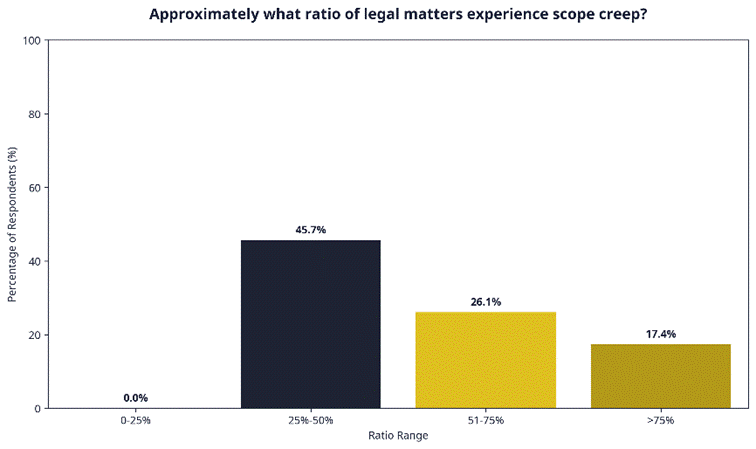
This uncontrolled expansion of work directly translates into financial overruns. The data shows a strong correlation between the frequency of scope creep and the likelihood of exceeding an agreed matter budget.
Approx 85% of respondents stated that more than a quarter of their matters go over budget. For many, the problem is even more severe, with 40% reporting that over half of their matters exceed their initial budget.
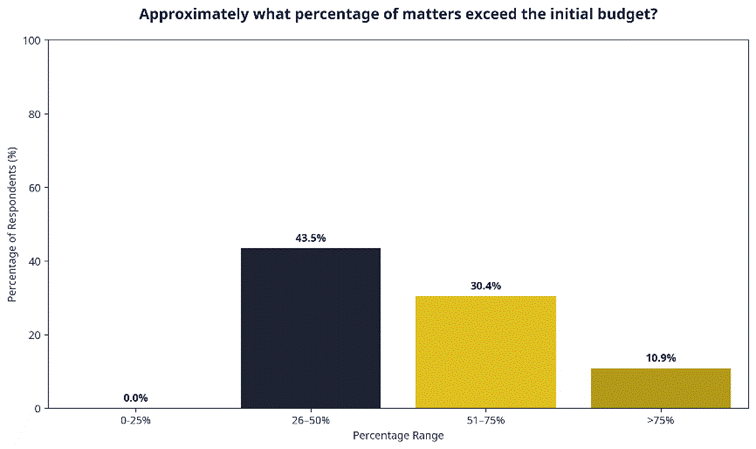
These are not just numbers; they represent lost revenue, profits, difficult client conversations, and exacerbate a fundamental lack of predictability in legal service delivery. The problem is compounded by the fact that the very process and tools meant to manage scope are falling short.
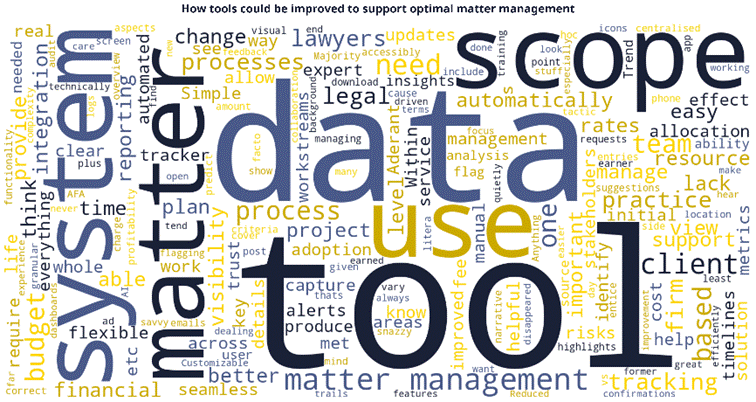
Despite this persistent problem, a staggering 70% of legal professionals are not satisfied with their current matter management tools. This indicates a significant gap between available solutions and industry needs.
While the toolset can be enhanced, the respondents provide clear explanations of why current tools are not meeting requirements and ideas for addressing the root causes of budget overruns and delivering legal services predictably.
2. Unpacking the root causes:
If the problem is so widespread, why has it been so difficult to solve? Our research points to a confluence of factors:
- Inconsistent tracking: The most common methods for tracking scope changes are emails and manual notes. These are unstructured, difficult to search, and fail to provide a single source of truth. As one respondent noted:
“We do not formally track scope changes… [it’s] not efficiently managed. Primitive ways are still widely used, like Excel, Word, and OneNote.”
- Misaligned expectations: Often, the granular details of a project’s scope are discussed on a kick-off call but not kept top of mind, let alone formally documented. This leads to a disconnect between the client’s expectations and the law firm’s understanding of the work required. This is particularly problematic when team members change mid-matter, leading to a loss of institutional knowledge.
- The difficulty of saying “No”: Lawyers are trained to be client-centric, which can make it difficult to push back on requests that fall outside the initial scope. Without a practical process for managing these requests, they are often absorbed into the existing workstream, leading to unbilled work and reduced profitability.
- Real-time visibility: By the time most teams realise a budget has been overrun, it’s too late. The data is often backwards-looking, making it impossible to take proactive measures. One respondent lamented the difficulty in pinpointing overruns, stating:
“It usually involves going back through emails, time entries, and meeting notes, which can be time consuming.”
3. Budget overruns:
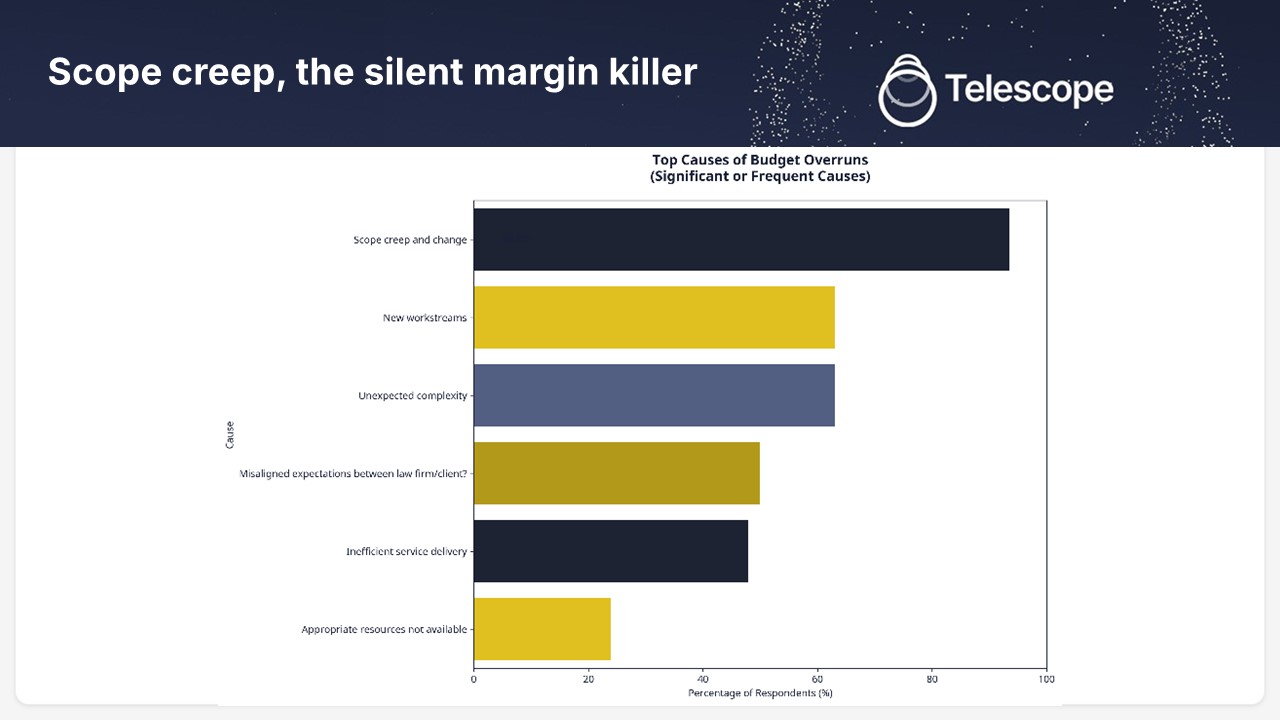
The primary culprits behind these financial deviations are clear. When asked to identify the primary causes of budget overruns, respondents overwhelmingly pointed to three factors directly related to poor scope definition and management:
- Scope creep and change
- New workstreams
- Unexpected complexity
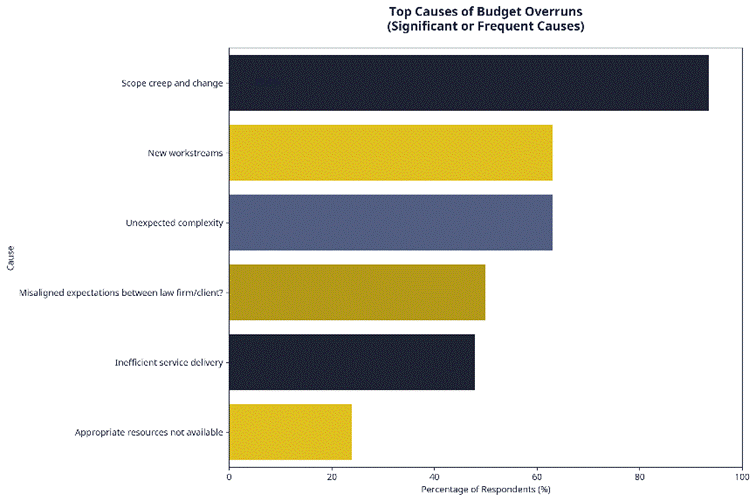
This data confirms that the core challenge is not merely technical legal work, but the management of the engagement itself. The legal industry is struggling to contain the boundaries of its work, leading to friction and eroded profitability.
While certainly difficult obstacles to overcome for legal teams, with the right data to support Partners and Clients, it’s reasonable to expect that, in the age of AI, legal teams will be able to predict with greater accuracy where there is exposure to these drivers and better prepare, plan, and budget for all eventualities.
4. It’s more than just money
The financial cost of scope creep is significant, but its impact extends far beyond the bottom line:
- Client relationships: Surprise invoices and budget overruns are a major source of friction between law firms and their clients. They erode trust and can damage long-term relationships and repeat instructions.
- Team burnout: Constantly working beyond the agreed-upon scope can lead to team burnout and low morale. It creates a sense of chaos and the feeling that projects are never truly under control, as the goalposts constantly shift.
5. A shift to proactive matter management
Solving the problem of scope creep requires a fundamental shift in how legal matters are managed. It requires moving from a reactive, archaeological approach, from digging through emails to figure out what went wrong. To a proactive, real-time model, where technology must play a transformative role.
The legal industry needs tools that are:
- Centralised: A single platform that provides a shared understanding of a matter’s scope, budget, and progress for both the law firm and the client.
- Real-time: Dashboards and early warning alerts using leading, not lagging, indicators. Enabling law firms to make data-driven decisions before the problems occur.
- Simple and intuitive: Tools that are so easy to use that they meet users where they work and become a natural part of the workflow, not an administrative burden.
6. Conclusion
Scope creep is a silent but formidable threat to the profitability, sustainable client relationships and predictable legal service delivery. Our research confirms that it is a pervasive, industry-wide challenge that current tools and processes are failing to address. The data is clear: the time for manual, fragmented, and reactive matter management is over.
By embracing technology that provides real-time visibility and facilitates transparent communication, the legal industry can finally tame the beast of scope creep, leading to more predictable outcomes, stronger client relationships, and a more sustainable way of working.
The author
By Aaran Scott, a global legal operations strategist and founder of Telescope, drawing on 10+ years of partnering with leading law firms to transform matter management and deliver exceptional client value.
References
[1] Project Management Institute. (2021). Pulse of the Profession 2021.
[2] Gartner, Only 20% of Legal Matters Stay Within Budget Range
About Telescope
Telescope is redefining how legal matters are managed, bringing visibility, control, and confidence to every stage of a case or transaction. Built for modern legal teams, our platform connects scope, delivery, and value through an intelligent matter management system that goes far beyond task tracking.
We enable firms and in-house teams to scope complex projects accurately, monitor progress in real time, and manage costs with precision.
Next-generation matter management starts here — contact us at Telescope.