Why Legal Teams Need a Better Delivery Framework
For years, corporate legal departments and law firms have invested heavily in technology to improve efficiency, gain operational visibility, and control external spend. More recently, significant sums have been diverted toward Generative Artificial Intelligence (GenAI). Yet despite this proliferation of advanced legal tech solutions, many legal organisations continue to face the exact same recurring pain. Despite significant investment in legal technology and, more recently, GenAI, many legal organisations face the same recurring problems: matters exceeding budget, scope drifting mid-stream, unreliable forecasting, and difficulty demonstrating value to executive stakeholders. Research from Gartner confirms that only 20% of complex legal matters stay within budget. The issue is rarely the technology. More often it is the absence of structured processes around how legal work is scoped, planned, managed, and delivered.
Technology does not fix a broken process. It amplifies it. A matter management platform built on inconsistent scoping habits produces inconsistent data faster. A GenAI tool trained on poorly structured matter files reflects that disorder in its outputs. Organisations that get the most from their technology investments are those that have already done the harder work of defining how they operate, what they measure, and where their delivery breaks down. The technology then has something solid to build on.
The Four Stages of Legal Matter Delivery
Addressing this requires a rigorous look at the four core stages of the matter lifecycle.
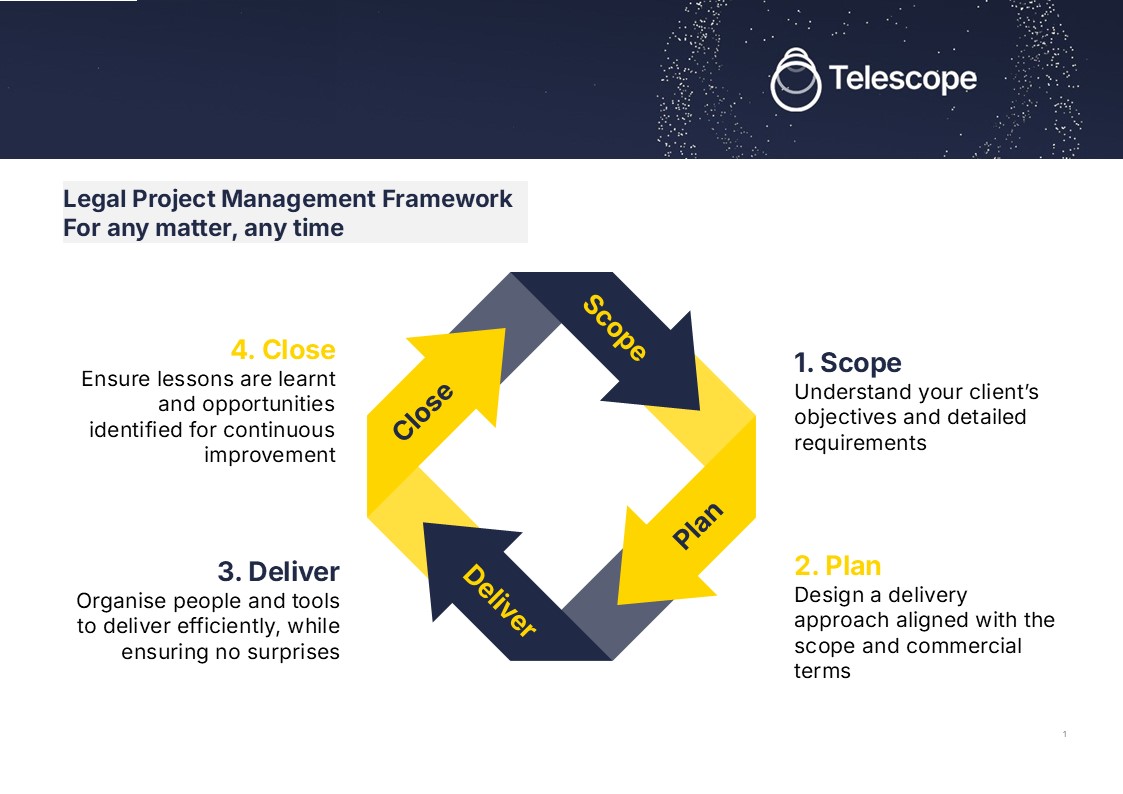
1. Scope: Aligning Expectations
Poor initial scoping is the primary driver of project failure and cost overruns. In legal delivery, assumptions go unvetted, requirements evolve undocumented, and matters begin without agreed objectives, boundaries, or risk definitions. PMI’s Pulse of the Profession found that 55% of projects experience scope creep, and of those, 85% exceed their initial budgets with average overruns of 27% (PMI, 2024). In a client-facing environment those overruns don’t just affect margin. They erode trust. Signing off objectives, deliverables, and boundaries before work begins radically improves forecasting and reduces costly surprises.
2. Plan: Shifting from Reactive to Proactive
Successful delivery starts before substantive legal analysis begins. Departments that implement disciplined planning frameworks, phased work breakdowns and resource allocation models, report significantly higher stakeholder satisfaction (ACC, 2024). Staff allocation, budgeting, and capacity management should be calculated deliberately, not handled reactively under pressure.
3. Deliver: Establishing Governance and Metrics
As matters evolve, maintaining manual control becomes exponentially harder. Standardised governance structures and reporting cadences, with formal status tracking and variance analysis against planned baselines, allow teams to identify deviations early enough to course-correct rather than conduct post-mortems on blown budgets.
4. Close: Capturing Institutional Intelligence
The close-out phase is where institutional learning is captured and where the billing conversation is either resolved or where it unravels. When scope has been agreed upfront, changes tracked and approved throughout, and the client kept informed, the invoice is simply the confirmation of what was already understood. The version legal teams dread, a surprised client, drifting scope, and the choice between a write-off or a damaged relationship, is entirely avoidable. It is also entirely predictable when close-out is treated as administrative tidying rather than the final test of whether the matter was managed well. Billing clarity is not a financial discipline applied at the end. It is the commercial outcome of process discipline applied throughout.
Technology Enabled, Not Technology Led
A sustainable legal department must be technology-enabled rather than technology-led. The framework must always begin by identifying the root business problem, mapping the baseline process, and establishing firm governance before deploying technology. Implementing advanced software on top of poorly defined processes only accelerates bad data and compounds operational confusion.
BCG’s research across 1,000 senior executives from 59 countries found that organisations achieving sustained value from AI allocate 70% of their effort to people and process change, 20% to technology and data, and just 10% to the algorithms themselves (BCG, 2024). Most organisations invert that ratio. The same study found only 26% have developed the capabilities to move beyond proofs of concept and generate tangible value. The gap between AI investment and AI return is primarily a people and process problem.
The Thomson Reuters Institute’s 2026 AI in Professional Services Report is clear: GenAI use has nearly doubled to 40%, yet 2026 is explicitly framed as the “strategic phase” in which organisations must redefine workflows and embed AI into the foundations of how they operate (Thomson Reuters Institute, 2026). Adoption has outrun readiness. AMRU Consulting’s LPM to AI Readiness Diagnostic was developed for precisely this gap, assessing process maturity across scoping, planning, delivery, and close-out before any technology recommendation is made. The barriers to effective AI adoption are operational, not technical. They are fixed through discipline, not software.
The future of legal service delivery will not be defined by technical expertise or software budget alone. It will be defined by an organisation’s ability to deliver that expertise with structural visibility, rigorous control, and commercial predictability.
The Co-Authors
By Aaran Scott, a global legal operations strategist and founder of Telescope, drawing on 10+ years of partnering with leading law firms to transform matter management and deliver exceptional client value.
By Amar Sohal, founder of AMRU Consulting, a boutique consultancy specialising in Legal Project Management, Legal Transformation, and Business Transition. With over twenty years of senior experience working with leading law firms and major corporates, Amar works with law firm leadership, General Counsels, and in-house legal teams to build the operational foundations that make meaningful change possible, and technology investment worthwhile.
- Association of Corporate Counsel (ACC). (2024). Legal Operations Maturity Benchmarking Report. ACC Research
- Breydo, L. E. (2026). Rewired: Reconceptualising Legal Services for the AI Age. Northwestern Journal of Technology and Intellectual Property, 23(2), 1-45
- Gartner. (2024). Gartner Magic Quadrant for Legal Matter Management. Gartner Research
- Thomson Reuters Legal Executive Institute. (2025). Report on the State of the Legal Market: Changing Dynamics in In-House and Law Firm Operations. Thomson Reuters
- Boston Consulting Group (BCG). (2024). Where’s the Value in AI? BCG
- Project Management Institute (PMI). (2024). Pulse of the Profession. PMI
- Thomson Reuters Institute. (2026). AI in Professional Services Report. Thomson Reuters