1. The Hidden Cost!
At Telescope, we estimate that scope creep is costing more than $45b annually in lost law firm revenue across the UK and US legal markets. The often-overlooked impact is the erosion of client trust, as unpredictable scope and pricing undermine confidence long before margins are lost. Law firms that choose to tackle scope management head-on can turn this hidden cost into a competitive advantage, delivering clarity, confidence and stronger client relationships.
What the Data Tells Us:
Scope creep is not anecdotal; it is structural. Research from Gartner [1] states that only 20% of matters stay within budget, and Thomson Reuters [2] reports that a significant proportion of legal matters exceed original budgets, with scoping changing on up to 75% of matters, and 30% of matters undergo significant scope change, not to mention late-stage changes cited as a primary driver of variance. Many other law firm surveys link this directly to margin leakage through write-offs, discounting, and unrecovered effort, while in-house research highlights that lack of upfront scope clarity is one of the leading causes of fee disputes and strained firm relationships. The data is unequivocal: when scope is implicit, outcomes become unpredictable, and predictability is now one of the most valued attributes clients seek from their external counsel.
2. What is the cost of misaligned expectations?
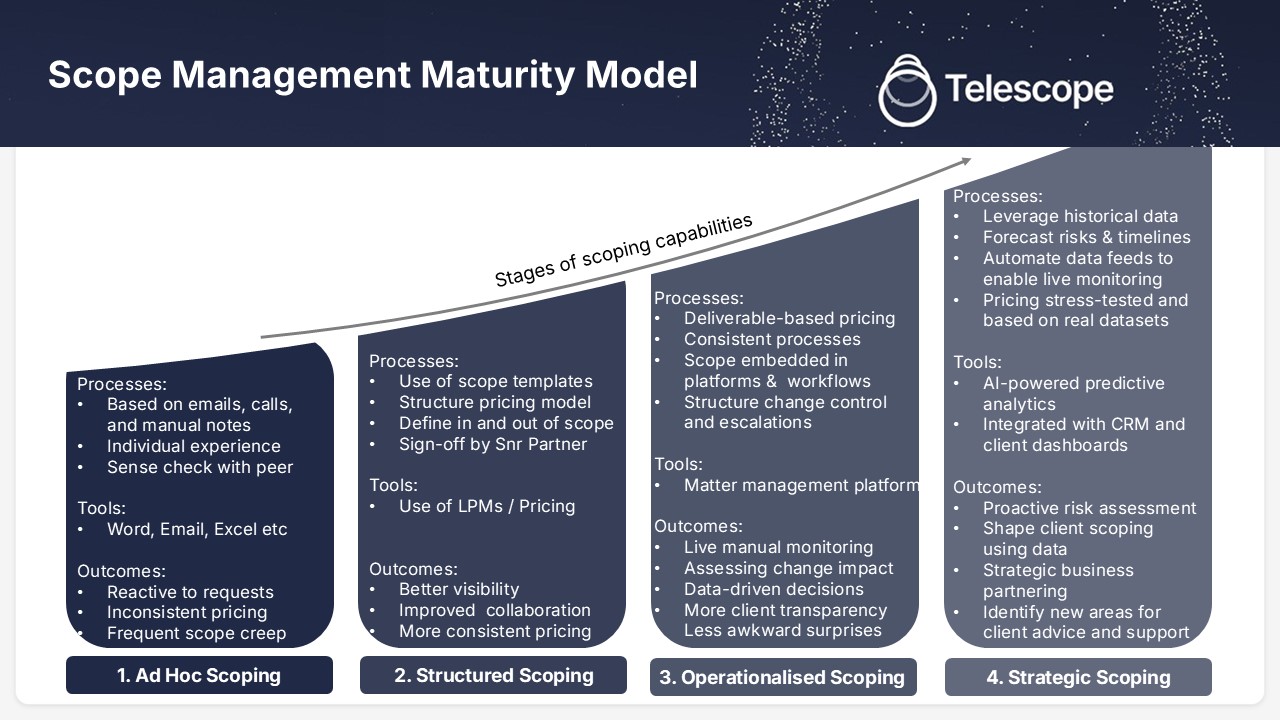
Imagine a “straightforward” framework agreement that turns into a six-month ordeal, blows the budget, and ends in a massive write-off. The culprit wasn’t legal expertise; it was a scope that was never truly defined. This isn’t isolated; it’s systemic. Scoping breakdowns are invisible until they become financial and relational disasters.
The Three Blind Spots Where Scope Breaks Down:
- Unspoken Assumptions: If you haven’t asked the question and documented the answer, you’re operating on a guess.
- Fuzzy Perimeters: Without clear deliverables, scope expands invisibly as every stakeholder interprets the brief differently.
- Ignored Dependencies: When we don’t map dependencies, the business asks _”Why so long?”_ while the firm asks _”Why are we penalised for waiting?”
The “Ostrich Policy” Hidden Costs!
Beyond overruns, the real damage is psychological: The Law Firm’s “Fear of the Ask”: The partner sees scope creepingbut waits until the bill is due to raise it, fearing they’ll look greedy.
The In-house “Fear of the Slip”: The Legal PM sees the matter derailing but lacks hard data to justify a budget increase.
This mutual silence is a time bomb. Many lawyers still view scoping as administrative overhead, not realising their email-based instructions are systemic failures. Relying on a January email to govern a June reality isn’t just old-fashioned, it’s a recipe for professional friction.
Impact over time: Scope failure rarely shows up as a single event; it compounds across delivery, pricing, and communication. By the time it appears on an invoice, the financial impact has already occurred, and the trust impact is much harder to reverse.
3. Scope Management, Legal Services Capability Model
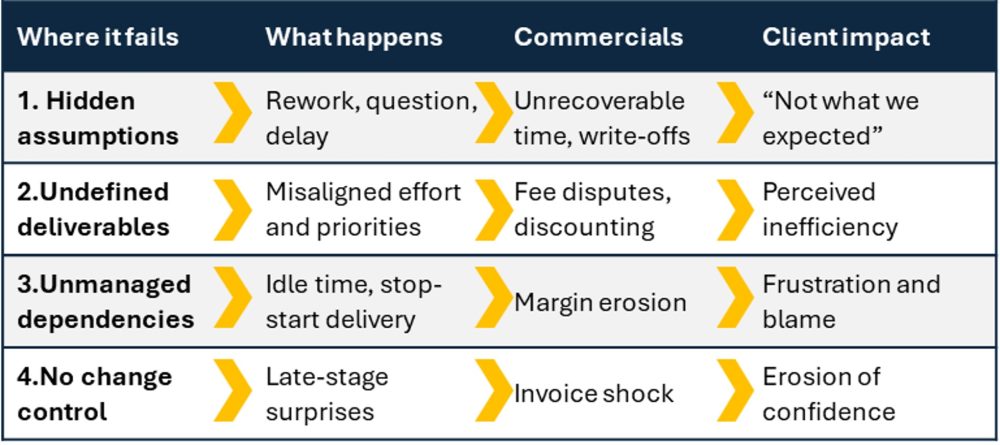
Telescope’s Scope Management Maturity Model shows how legal teams can progress from ad hoc, experience-driven scoping to a strategic, data-led capability embedded across people, processes and platforms. By investing in this capability, firms reduce scope creep, improve pricing confidence and transparency, and proactively manage risk, resourcing and change. Mature scope management enables more predictable outcomes, stronger client trust and positions firms as strategic business partners—using real data and insight to shape work, not just react to it.

For your reference, you can access a short, practical scope self-assessment checklist here. It’s designed to be completed in 2 minutes and to help you identify where you sit on the Scope Management Maturity model.
4. Working with Law Firms — From Price Negotiation to Scope Alignment
The best legal partnerships don’t start with a rate card; they start with a conversation about what ‘done’ looks like and what could derail it. High-performing teams treat scoping as a shared delivery framework that protects both sides. See complimentary paper Beyond the RFP: Embracing Effective Fee Management in Legal Services [3].
Why Estimates Miss the Mark: Most estimates fail because they’re built on incomplete information from both sides. Without understanding the client’s constraints or surfacing their own assumptions, firms are guessing. For in-house teams, precise scoping isn’t micromanagement; it’s the essential enabler of Fixed Fees.
“Without clarity, a “Fixed Fee” is just a ticking time bomb.“
What Must Be Defined Upfront (The “Core Four”):
Managing Change Without Friction: The scope will change. Friction occurs when change is treated as failure rather than as reality. Replace awkward conversations with a Scope Change Note: trigger, impact, revised estimate, and client confirmation. It transforms scope changes from ‘gotcha’ moments into collaborative adjustments.
- Deliverables: Not “advice,” but “a 3-page memo and 2 negotiation rounds.”
- Assumptions: Based on 15 contracts, English law, no regulatory filing.”
- Dependencies: “We need final input by Day 10. If delayed, timeline adjusts.”
- Out-of-Scope Triggers: Define what will officially change the scope before it happens.
5. Conclusion: Scoping as a Strategic Advantage
Scope is no longer a delivery detail; it is a strategic differentiator.
In an environment where clients demand predictability, transparency, and commercial alignment, the firms that win will not be those with the lowest rates, but those that consistently deliver against clearly defined expectations. Scope discipline is the mechanism that enables this.
When scoping is weak, the consequences are predictable: budget overruns, write-offs, delayed matters, strained relationships, and erosion of trust. These failures are rarely caused solely by legal complexity. They are the result of assumptions left untested, dependencies left unmanaged, and change left unspoken until it becomes contentious.
By contrast, firms that treat scoping as a core operational capability, embedded across people, processes, and platforms, unlock three compounding advantages:
- Commercial confidence: Better pricing accuracy, fewer write-offs, and greater margin control.
- Client trust: Fewer client surprises, earlier conversations, and shared accountability for the change.
- Strategic positioning: A shift from reactive service provider to proactive delivery partner and trusted advisor.
Scoping is not a procurement exercise, a one-off document, or an administrative burden. It is a continuous discipline that shapes how work is delivered, how value is perceived, and how trust is built.
The firms that master scoping do not eliminate change; they manage it visibly, collaboratively, and without friction. In doing so, they remove invoice shock, replace difficult conversations with structured and data-driven decisions, and create predictability in an inherently uncertain profession.
In a market where differentiation is increasingly hard to sustain, the ability to never have an unexplained overrun may be one of the most powerful competitive advantages a law firm can build.
Closing thought: To conclude, we leave you with one final thought:
“If your firm removed unexplained cost overruns tomorrow, what would that do to margin, client trust, and firm growth?”
About Telescope
Telescope is redefining how legal matters are managed, bringing visibility, control, and confidence to every stage of a case or transaction. Built for modern legal teams, our platform connects scope, delivery, and value through an intelligent matter management system that goes far beyond task tracking.
We enable firms and in-house teams to scope complex projects accurately, monitor progress in real time, and manage costs with precision.
Next-generation matter management starts here — contact us at Telescope.
The co-authors:
By Aaran Scott, a global legal operations strategist and founder of Telescope, drawing on 10+ years of partnering with leading law firms to transform matter management and deliver exceptional client value.
By Quentin Peltier, a Legal Ops expert with 10+ years of experience in top-tier firms and global legal departments. He helps overwhelmed legal teams build simple systems that restore impact, clarity, and serenity.
References:
[1] Gartner, Only 20% of Legal Matters Stay Within Budget Range
[2] Thompson Reuters, 2022 State of Corporate Law Departments
[3] Telescope, Beyond the RFP: Embracing Effective Fee Management in Legal Services