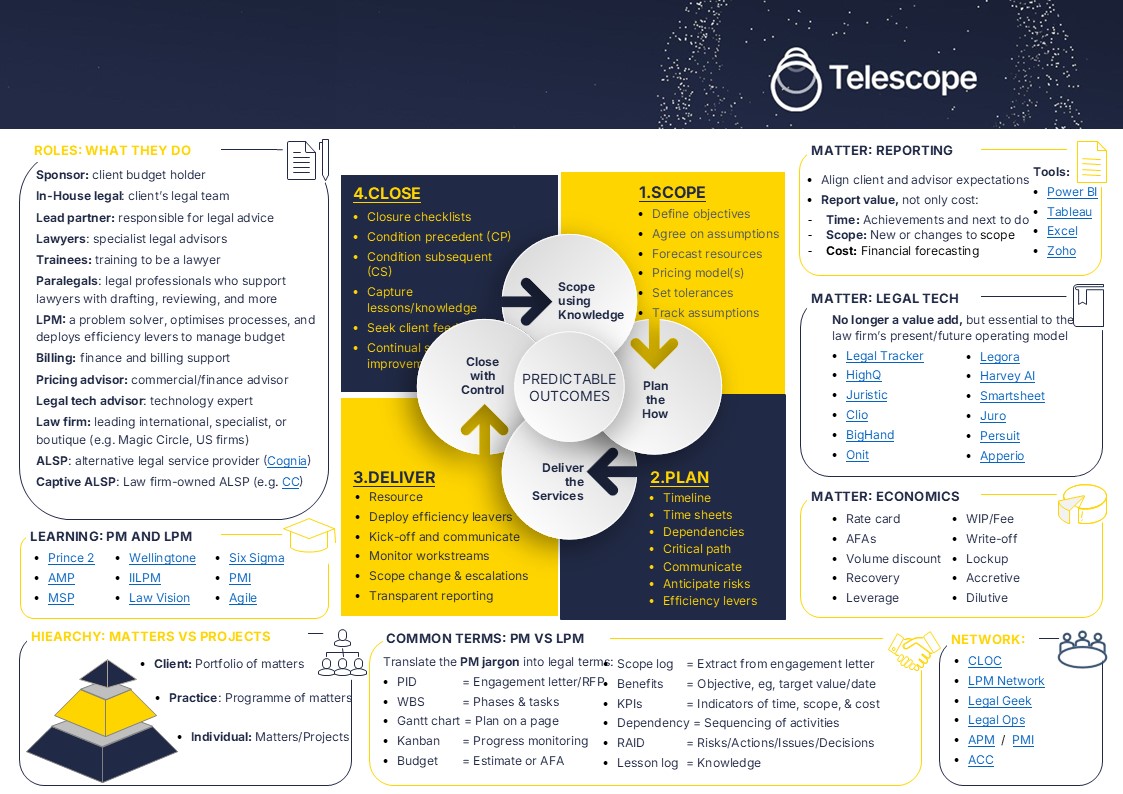
Legal Project Management: What it is and what a Legal Project Manager does
Legal work is becoming more complex; clients expect greater transparency; and law firms are under increasing pressure to adopt Artificial Intelligence (AI) while delivering high-quality legal advice within agreed budgets and timelines.
Legal Project Management (LPM) provides the framework for making that happen.
At its simplest, LPM brings the disciplines of project management to legal matters, helping legal teams define the scope of what needs to be delivered, plan how it will be delivered, manage resources and budgets, and keep the matter on track as it unfolds.
But effective LPM is more than creating a project plan or tracking a budget.
It is about actively managing the interdependent relationship between scope, resources, time, budget and client expectations throughout a matter.
What is Legal Project Management?
Legal Project Management is a structured approach to planning and managing legal matters so that the legal team and client have a shared understanding of:
- What needs to be delivered
- When it needs to be delivered
- Who will deliver it (partners, associates, paralegals, legal technology, AI)
- How the work will be delivered
- What it is expected to cost
Good LPM starts before the work begins and continues throughout the matter.
It connects the commercial assumptions made during scoping and pricing with what happens during the matter.
This is important because the original scope, budget and resourcing plan are rarely static. Priorities change, new issues emerge, timelines shift, teams change, and all of it needs to be actively managed against the original scope and price.
Without active management, these changes can lead to scope creep, budget overruns, inefficient resourcing, and difficult client conversations at the end of the matter.
We do not have an LPM in our Firm!
Legal Project Management is more than a job title or a dedicated team. While there are specialist Legal Project Manager roles, which we’ll explore shortly, LPM is fundamentally a framework for managing legal matters effectively. You can see our matter management framework here. The principles of LPM can be adopted by partners, lawyers, legal operations teams, finance teams and dedicated LPM professionals.
You don’t need a large team of LPMs to embed LPM across your firm. The goal is to build an effective approach to LPM into every matter, every time, to ensure they are scoped, planned, resourced, delivered and reviewed, with the right people taking responsibility at the right points in the matter lifecycle.
A dedicated LPM can provide additional expertise, structure and challenge, particularly on complex matters. But the underlying LPM approach can and should be adopted across the firm.
LPM is not just a role. It is a way of working.
What does a Legal Project Manager do?
A Legal Project Manager acts as the bridge between legal strategy, matter delivery and commercial management.
The role varies between firms and matters, but typically involves helping the legal team to:
1. Define and manage scope: The LPM helps establish a clear understanding of what is and isn’t included within the matter. This creates a baseline against which changes can be identified and managed.
2. Build the matter plan: The LPM translates the legal team’s objectives into a practical delivery plan. This can include:
- Key activities and milestones
- Dependencies
- Responsibilities
- Critical dates
- Assumptions
- Risks and issues
- Client deliverables
The objective isn’t bureaucracy. It is creating enough structure to help the team deliver effectively.
3. Align resources to the work: The LPM helps ensure that the right people are doing the right work at the right time. This means considering whether the actual resourcing approach remains aligned with the scope, budget and plan.
4. Manage financial performance: An LPM helps the team understand how the matter is performing against the agreed commercial parameters. Rather than simply reporting that fees have been spent, effective LPM examines why spending is changing and what can be done about it. This creates an opportunity to intervene while there is still time to influence the outcome.
5. Identify and manage change: Change is inevitable in legal matters. The role of the LPM is not to prevent change, but to make it visible, understood and managed. When scope, assumptions, timelines or resources change, the LPM can help assess the impact and facilitate the right conversation with the client and matter team.
6. Create visibility and communication: LPM provides a common view of the matter for partners, lawyers, clients and other stakeholders. Regular reporting and communication can help answer questions such as:
- Are we still delivering what we agreed?
- Are we on track?
- Are resources aligned with the work?
- Are there emerging risks to budget or timeline?
- What decisions need to be made now?
LPM is not just project administration
There is sometimes a misconception that Legal Project Management is primarily about producing reports, maintaining trackers or organising meetings.
Those activities can be part of the role, but they are not the purpose of LPM. The real value of LPM is helping legal teams make better decisions earlier.
A matter can have a perfectly maintained budget tracker and still be commercially off track. The difference is whether the information is being used to actively manage the matter.
For example, if a matter was priced on the assumption that 70% of work would be undertaken by associates, but the team is increasingly relying on partners, that is an important leading indicator. By the time the invoice indicates that the budget has been exceeded, the opportunity to correct the resourcing strategy may already have passed.
The Legal Project Manager as a core team player
The most effective LPMs don’t sit outside the matter looking in. They work alongside partners, lawyers and clients to create a shared understanding of how the matter will be delivered.
They can challenge assumptions, identify emerging risks, facilitate commercial conversations and help the team make informed decisions.
This makes the LPM a strategic partner to the matter team, rather than simply an administrator.
Why is Legal Project Management becoming more important?
The legal market is changing, and Clients increasingly want:
- Greater transparency
- More predictable costs
- Better value from legal spend
- Clearer communication
- Greater accountability for delivery
At the same time, law firms need to protect margins, demonstrate value-based pricing, manage increasingly complex matters and understand where commercial risk is emerging.
Technology and AI will continue to change how legal work is delivered. But technology alone does not solve the underlying management challenge. Law firms still need to know what they promised, what is happening and where the two are starting to diverge. That is where LPM becomes increasingly important.
From project management to active matter management
Traditional LPM has often focused on planning and reporting.
The opportunity now is to move towards active matter management, using data, AI and professional expertise to identify leading indicators and support intervention while there is still time to influence the outcome.
At Telescope, we believe this starts with one fundamental principle:
Scope with purpose. Deliver with confidence.
Discover how Telescope helps law firms turn LPM from a reporting function into a commercial engine
The Author
By Aaran Scott, a global legal operations strategist and founder of Telescope, drawing on 10+ years of partnering with leading law firms to transform matter management and deliver exceptional client value.