In an increasingly competitive legal landscape, the traditional Request for Proposal (RFP) and subsequent alternative fee arrangements (AFA) often fall short of delivering predictable outcomes and fostering strong client relationships. While there are great RFP tools like Persuit that aim to control costs, the reality is that final fees often diverge significantly from initial arrangements, leading to client dissatisfaction and eroded trust. This article, drawing on Telescope philosophy, advocates a paradigm shift towards alternative fee management (AFM), a proactive, data-driven approach that prioritises transparency, collaboration, and continuous monitoring throughout the legal project lifecycle.
The Pitfalls of Traditional Fee Arrangements
For too long, legal service procurement has relied heavily on RFPs, which, despite their intent, often create a transactional rather than a collaborative dynamic. The initial fee agreement, whether fixed or hourly, often serves as little more than a starting point. Factors such as scope creep, unforeseen complexities, new workstreams and inadequate communication can quickly derail these arrangements, resulting in budget overruns and write-offs for law firms.
As Aaran Scott, Founder of Telescope, highlights:
“Agreeing an alternative fee arrangement (AFA) is only the beginning; law firms and clients must collaborate closely to maintain rigorous scope control throughout the lifecycle of complex legal matters. Without robust scope management, even the best fee arrangements can fail to deliver value, leading to cost overruns, delays, and dissatisfied clients.” [1]
A reactive approach to fee management not only strains client relationships but also impacts law firm profitability. The lack of real-time visibility into matter progress, resource allocation, and potential deviations from the agreed scope makes it challenging to manage internal and external expectations and deliver client value in a predictable and transparent way.
The Imperative of Alternative Fee Management
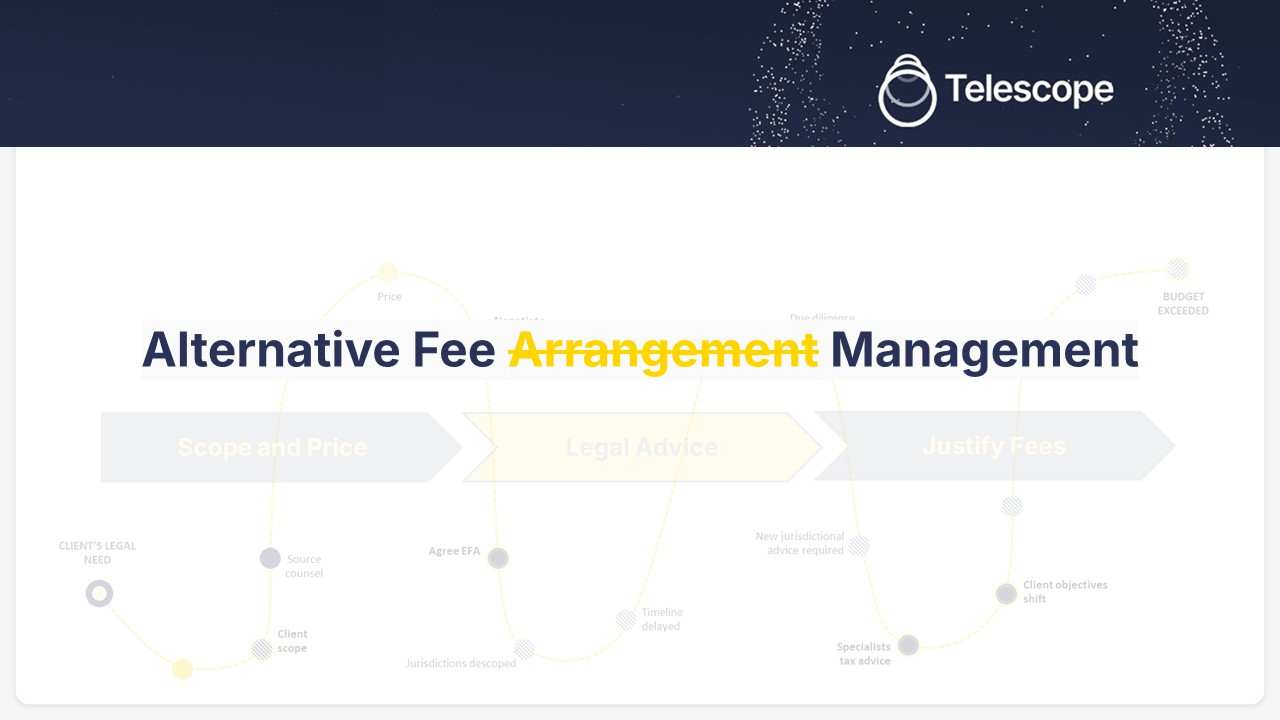
Alternative fee management (AFM) transcends the initial fee negotiation. It is a continuous process that integrates principles of matter management and legal project management with financial oversight, ensuring that legal services are delivered efficiently, transparently, and within agreed parameters. This approach is built on several critical pillars:
- Proactive Scope Definition and Monitoring: The foundation of alterative fee management lies in a clear, mutually understood scope. This involves more than just listing tasks; it requires defining objectives, assumptions, and deliverables with precision. Throughout the matter, continuous monitoring of the scope is essential to identify and address any potential creep or changes early. As Telescope emphasises, “Defining the scope accurately is crucial to avoid misunderstandings and misaligned expectations.” [1]
- Transparent Assumption and Timeline Management: Every legal matter operates on a set of assumptions and within specific timelines. Alternative fee management necessitates documenting these assumptions upfront and regularly reviewing them with the client. Any changes to these assumptions or timelines must trigger proactive discussions about their potential impact on fees and project trajectory. This transparency prevents surprises and allows for timely adjustments.
- Optimised Resource Allocation: How often does a law firm price a piece of work, only to find, when they come to staff the matter, that the profile of resources available is very different from how they priced it, immediately creating a risk to the budget? Efficient resourcing is directly linked to cost control. This involves strategically allocating the right personnel with the appropriate expertise to each task, avoiding both over- and under-resourcing. Monitoring resource utilisation against the budget and scope ensures that work is performed effectively without unnecessary expenditure.
- Data-Driven Client Discussions: Moving beyond anecdotal updates, alternative fee management relies on holistic data, not just budget and fees. Regular, structured client discussions should be informed by real-time data on progress against the timeline, budget consumption, and any scope deviations. This allows for objective conversations about value, potential risks, and necessary adjustments, fostering a partnership built on facts rather than assumptions. Telescope’s platform, for instance, aims to provide “visibility, control, and confidence to every stage of a case or transaction,” enabling firms to “monitor progress in real time, and manage costs with precision.” [2]
Next-Generation Matter Management
At Telescope, we champion this shift by providing both advisory services and a software platform designed to facilitate alternative fee management. Our approach integrates the four pillars of legal project management, 1. Scope, 2. Plan, 3. Deliver, and 4. Close, into a cohesive framework that supports proactive financial oversight. By enabling law firms to:
- Rootcause: Identify core reasons for write-offs and budget overruns.
- Profit: Optimise matter management to minimise write-offs and enhance profit.
- Trust: Monitor matters in real time, increase transparency, reduce surprises, and build stronger client trust.[2]
Telescope empowers legal teams to move beyond the limitations of traditional RFPs, AFAs, and reactive billing processes. It fosters an environment where fees are actively managed, client expectations are consistently met, and the value of legal services is clearly demonstrated.
Conclusion
The era of simply responding to RFPs and hoping for the best with fee arrangements is ending. The legal industry is evolving, and clients demand greater predictability, transparency, and value, while law firms are pressuring their partners to deliver greater profitability, not just revenue.
By embracing alternative fee management, characterised by proactive scope management, optimised resource allocation, and data-driven client discussions, law firms can not only enhance their profitability but also build stronger, more enduring relationships with their clients. This strategic shift is not just about managing costs; it’s about redefining how legal value is delivered to delight clients.
About Telescope
Telescope is redefining how legal matters are managed, bringing visibility, control, and confidence to every stage of a case or transaction. Built for modern legal teams, our platform connects scope, delivery, and value through an intelligent matter management system that goes far beyond task tracking.
We enable firms and in-house teams to scope complex projects accurately, monitor progress in real time, and manage costs with precision.
Next-generation matter management starts here — contact us at Telescope.
By Aaran Scott, a global legal operations strategist and keynote speaker, drawing on 10+ years of partnering with leading law firms to transform matter management and deliver exceptional client value.
References
[1] Aaran Scott. “Navigating scope management and effective fee arrangements.” LinkedIn. Available at: https://www.linkedin.com/pulse/navigating-scope-management-effective-fee-aaran-scott-szxre
[2] Telescope.”Matter Management, Unlocking Better Client Outcomes.” Available at: https://telescope.legal/matter-management/
One thought on “Beyond Legal RFPs: Embracing Alternative Fee Management in Legal Services”
Comments are closed.